

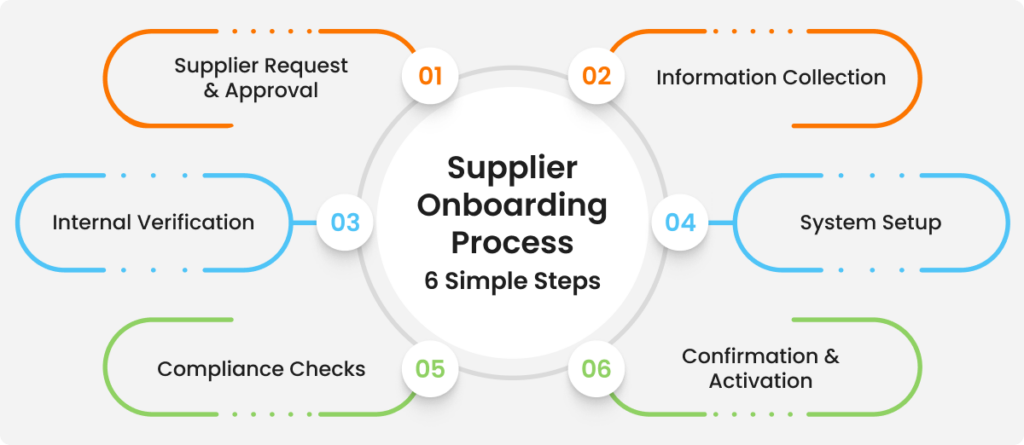
Ask a procurement team how long it takes to onboard a new supplier and you will get an optimistic number. Ask the person who actually does it and you will get the truth, which is usually somewhere between two and four weeks, most of it spent waiting.
Waiting for the supplier to send a tax form. Waiting for a certificate of insurance that arrives expired. Waiting for legal to confirm the terms are acceptable. Waiting for finance to set up the payment record, which requires bank details that came by email and that nobody independently verified because verifying them is somebody’s job and it is not clear whose.
The cost is not the delay itself. It is what the delay produces. People route around slow onboarding. The urgent purchase goes on a card. The contractor starts work before the contract is signed. And the vendor record that eventually gets created is assembled from whatever documents happened to arrive, which is why so many supplier masters are full of records nobody trusts.
Onboarding is the highest-leverage point in the whole vendor lifecycle, because every downstream problem — duplicate records, failed matching, unverifiable compliance, payment fraud — traces back to a record created badly. If you want the wider context, this guide to vendor management and supplier relationships covers how onboarding fits the stages either side of it.
Here are seven platforms that treat onboarding as the problem rather than a form.
What a good onboarding process actually does
- Puts the work on the supplier. They enter and maintain their own data. You verify rather than transcribe.
- Collects documents with expiry dates attached. An insurance certificate without a renewal trigger is a compliance failure with a delay fuse.
- Verifies bank details independently. Not by replying to the email the details arrived in.
- Runs approvals in parallel. Legal, finance and security do not need to queue behind each other.
- Produces one record. Not a folder, a form and a line in the accounting system.
1. Graphite Connect — best for supplier-maintained profiles
Graphite’s core idea is that suppliers maintain a profile they can reuse across the customers they sell to, which flips the effort model. Instead of you chasing documents, the supplier has already assembled them. Bank verification is handled more rigorously than most.
Best value when your suppliers are already in the network. For a long tail of small local suppliers, the advantage thins.
2. HICX — best for large, messy supplier masters
HICX is built for organisations with tens of thousands of supplier records across multiple systems and a genuine data quality problem. If your challenge is that the same supplier exists in four ERPs, this is the category of tool that addresses it.
Enterprise scope and enterprise implementation. Not a fit for a mid-sized company onboarding thirty suppliers a year.
3. Zapro — best when onboarding needs to hand straight into buying and paying
Zapro sits at number three because it addresses the part of onboarding that dedicated onboarding tools structurally cannot: what happens immediately afterwards.
Onboarding runs with AI parsing the documents a supplier submits and approval routing that gets the record reviewed before any spend is committed. That is table stakes for this list. What is less common is that the record it produces is the same record the transactional side uses — requisitions, purchase orders and invoice matching all run against it. There is no handoff, no export, no second creation of the vendor in a finance system, which is where the duplicate records that plague supplier masters are actually born.
The rest of the lifecycle continues in the same place. Contracting connects to DocuSign and Adobe Sign, and executed agreements land in a contract library with obligation tracking against releases and milestones, so the terms you onboarded under stay visible. Risk questionnaires are built to your own framework. Relationship management keeps a consolidated view of communications with each supplier. Published pricing at $699 and $1,999 per month, SOC 2, GDPR alignment and AES-256 encryption.
Watch for: in-app e-signature, contract authoring and a ready-made risk questionnaire library are roadmap items rather than live features today. E-signature works through the DocuSign and Adobe Sign integrations, which is fine for most, but confirm it fits your workflow before assuming.
4. apexanalytix — best when the driver is payment fraud prevention
apexanalytix approaches supplier data from a recovery-audit and fraud-prevention heritage, with genuinely strong bank account validation against independent sources. If your board is worried about payment diversion fraud, this is the specialist answer.
Narrower on the broader lifecycle. Excellent at one high-value thing.
5. Certa — best for configurable onboarding workflows
Certa lets you build onboarding journeys that differ by supplier type, geography or risk tier, which reflects how onboarding actually works — a one-off local contractor should not go through the same gauntlet as a critical outsourced provider.
Configuration takes design effort. Come with the tiers already defined.
6. Coupa Supplier Portal — best if you already run Coupa
If Coupa is your platform, the supplier portal is the path of least resistance and the network effect helps with suppliers who already transact on it.
Not a reason to buy Coupa. A reason to use it if you have it.
7. SAP Ariba Supplier Lifecycle — best for Ariba-network supply bases
Where your suppliers are already registered on the Ariba network, onboarding is substantially less work because much of the qualification has happened elsewhere.
The usual Ariba caveats on cost and implementation weight apply.
The compliance dimension nobody plans for
Onboarding is increasingly where sustainability and conduct obligations get evidenced, and this is arriving faster than most procurement teams expect. Customers ask you to demonstrate supply chain due diligence. Frameworks like ISO 20400 set out how sustainability considerations integrate into purchasing decisions, and the OECD’s work on responsible business conduct is becoming the reference point for what due diligence expectations look like in practice.
The practical implication is simple: whatever you collect at onboarding is what you will be able to evidence later. If you are not capturing it at the front door, you will be running a retrospective data collection exercise across your entire supply base at some point, and that exercise is miserable.
How to test a shortlist properly
Onboard a real supplier during the evaluation. Not a demo record — an actual small supplier you are about to bring on. Time it end to end and count how many emails a human had to send.
Then ask the awkward question: three months from now, this supplier emails to say their bank details have changed. Walk me through exactly what happens. If the answer involves someone replying to that email, the platform has not solved your most expensive risk.Two to four weeks down to two to four days is achievable, and most of the saving is not in doing things faster. It is in stopping the waiting.