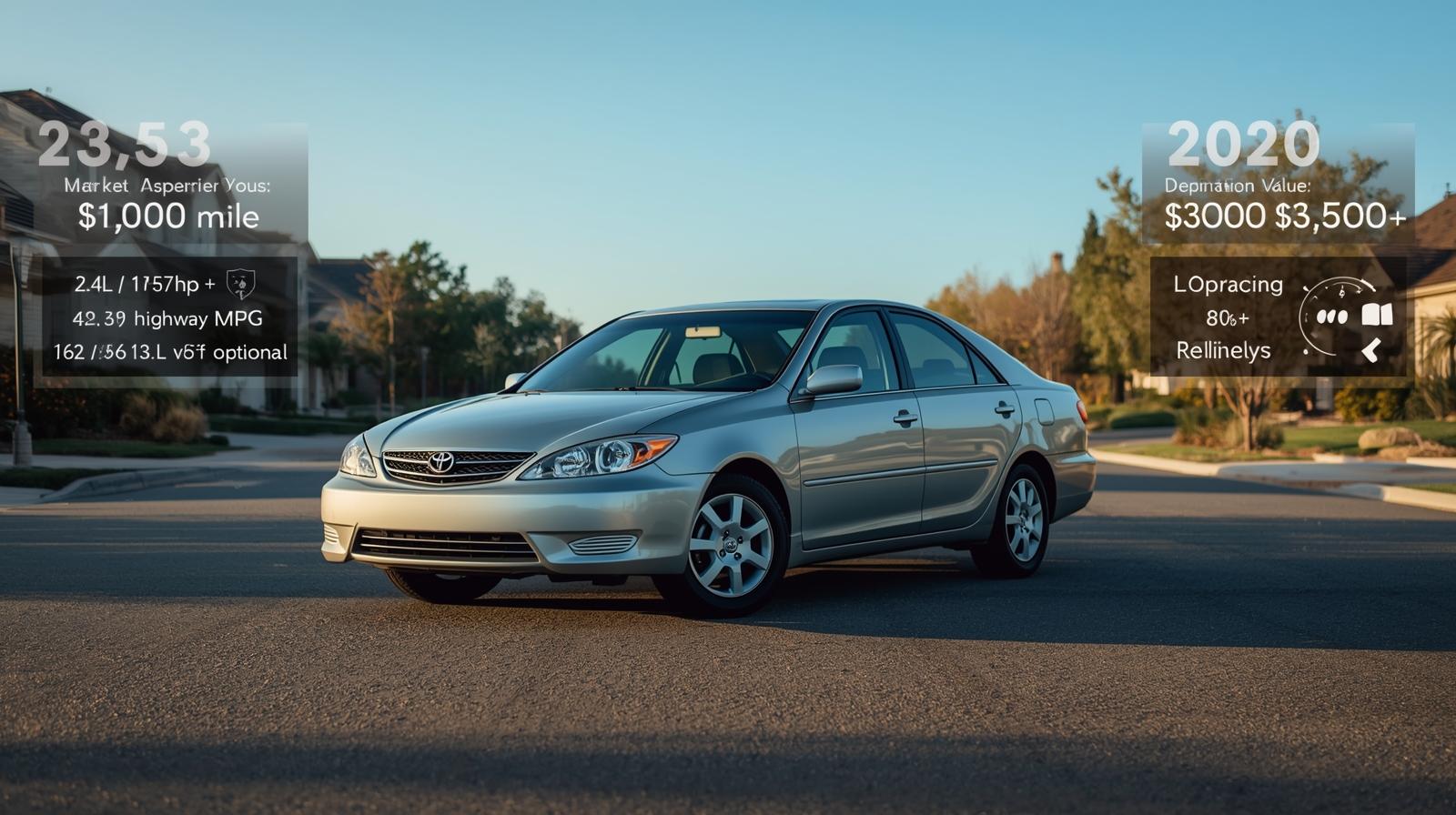
2004 Toyota Camry LE | Specs, Value & Reliability
You found a clean older sedan for a reasonable price, and now you are asking the right question: is this 20-year-old car still a smart buy? I have tracked the used car market for more than a decade, and few models come up as often as the 2004 Toyota Camry LE. Buyers want something dependable, affordable, and easy to maintain. This model has built a reputation for all three.
Over the years, I have driven multiple examples of the Toyota Camry LE 2004 and spoken with owners who crossed 250,000 miles without major drama. That matters in 2026, when used car prices remain elevated. Here is what you will learn: detailed 2004 Toyota Camry LE specs, real-world reliability, common problems, ownership costs, and whether it still makes financial sense compared to rivals like the 2004 Honda Accord.
Is the 2004 Toyota Camry LE Still Worth Buying in 2026?
Short answer: for the right buyer, yes.
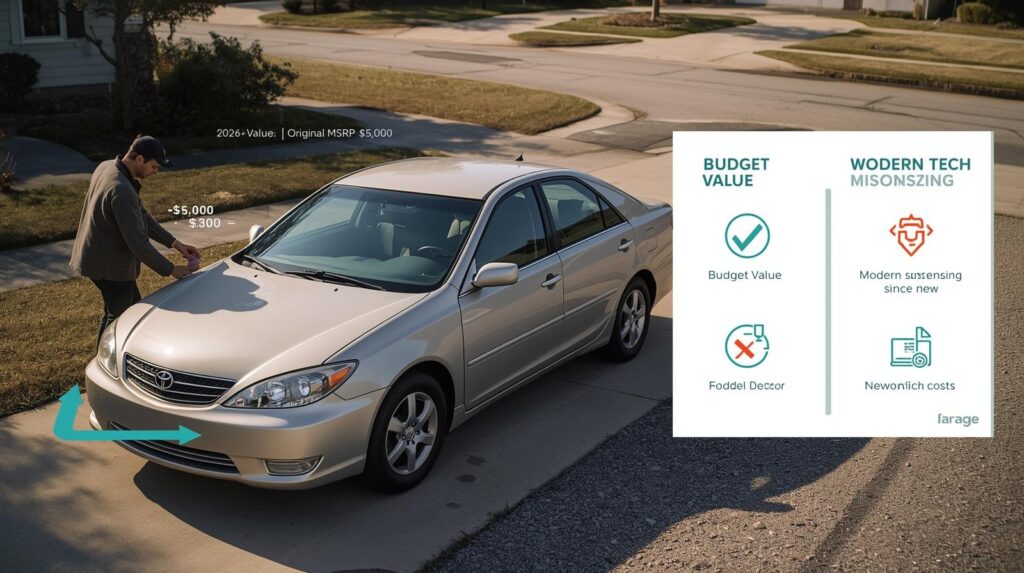
When new, the LE trim carried an original MSRP between $19,000 and $21,000 (Source: Toyota USA press materials, 2004 model year). Adjusted for inflation, that sits closer to mid-$30,000 territory today. In 2026, clean examples trade between $3,000 and $6,500 depending on mileage and condition (Source: Kelley Blue Book valuation data, January 2026). That is more than 80 percent depreciation over its lifetime (Source: CarEdge depreciation data for 2004 Camry).
The heavy depreciation already happened. You are buying near the bottom of the curve. However, age introduces risk. Rubber components, suspension parts, and electronics can fail simply due to time. This is no longer a cheap commuter with zero worries. It is a budget car that demands inspection. If you need basic, comfortable transportation and can handle occasional repairs, it remains a strong value. If you want modern safety tech and near-zero maintenance, look elsewhere.
2004 Toyota Camry LE Specs and Configurations
Let us break down the 2004 Toyota Camry LE configurations clearly.
The LE trim sat in the middle of the lineup, above CE and below XLE. It was available with a 2.4L four-cylinder or an optional 3.0L V6. Most LE models on the market carry the four-cylinder.
Specifications Table
| Specification | Detail |
| Engine (Base) | 2.4L inline-4 |
| Horsepower | 157 hp @ 5,600 rpm |
| Torque | 162 lb-ft @ 4,000 rpm |
| Optional Engine | 3.0L V6 |
| V6 Horsepower | 210 hp |
| Transmission | 4-speed automatic |
| Drivetrain | Front-wheel drive |
| Fuel Economy (I4 Auto) | 21 city / 29 highway MPG |
| Fuel Tank | 18.5 gallons |
| Seating Capacity | 5 passengers |
| Curb Weight | Approx. 3,100–3,300 lbs |
| Airbags | Dual front standard, side optional |
Source: Toyota Technical Specifications and 2004 Toyota Camry LE manual.
Standard features included power windows, power locks, air conditioning, cruise control, and keyless entry on many models. For 2004, that was competitive.
Engine, Performance and Fuel Economy
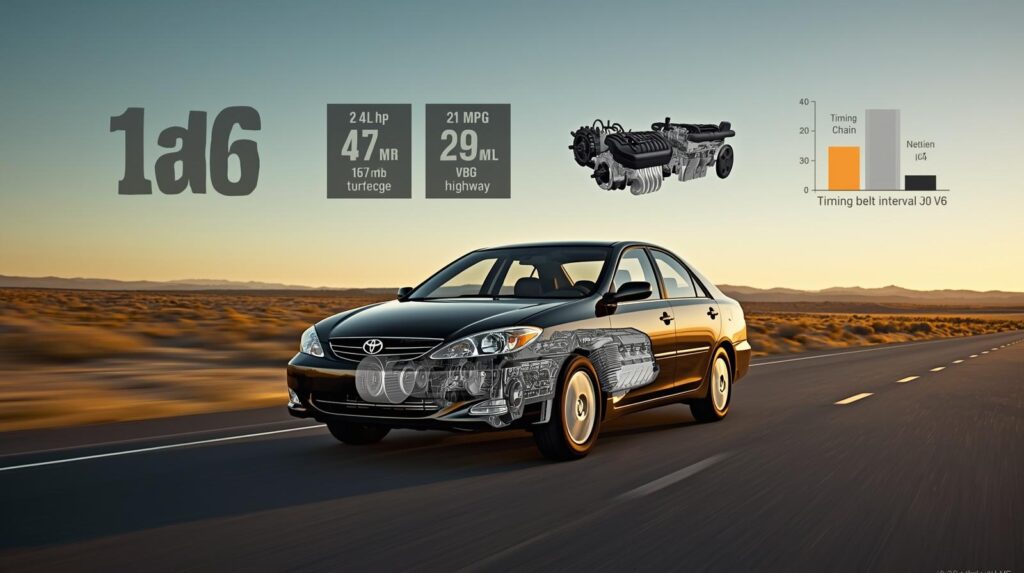
Most buyers choose the 2.4L four-cylinder. It produces 157 horsepower and 162 lb-ft of torque (Toyota Technical Specifications). Acceleration feels adequate, not exciting. Zero to 60 mph takes around 9 seconds based on period testing from Car and Driver (2004 road test data).The optional 3.0L V6 pushes output to 210 horsepower. That version feels much stronger on highways and during passing. Fuel economy remains respectable. The four-cylinder automatic earns 21 city and 29 highway MPG (EPA data via Toyota specifications).
Compared to modern midsize sedans that average 30–35 MPG combined, it is slightly behind but still acceptable. One key mechanical detail: the four-cylinder uses a timing chain, while the V6 requires a timing belt replacement at recommended intervals (Source: Toyota 2004 owner documentation). That matters for maintenance costs. For daily commuting, the four-cylinder is the smarter long-term choice.
Reliability Record and Longevity
Is a 2004 Toyota Camry LE reliable?
Historically, yes. The Camry has consistently ranked well in dependability studies. J.D. Power Vehicle Dependability Studies frequently placed Toyota near the top during the early 2000s (Source: J.D. Power VDS archives). Consumer Reports rated the 2004 Camry above average in predicted reliability in its annual auto issue (Consumer Reports Auto Issue, mid-2000s archive data). How many miles can it last? Many documented examples exceed 250,000 miles, and some surpass 300,000 miles with proper maintenance.
That is not marketing hype. Independent forums and long-term owner reports confirm it. The 2.4L engine is generally durable if oil changes are done regularly. The transmission, while not sporty, tends to hold up if fluid is serviced. Longevity depends on maintenance history. A neglected Camry will not magically survive because of the badge.
Common Problems, Recalls and Maintenance Costs
No car is perfect.
Common issues on the 2004 Camry include oil consumption on some four-cylinder engines, worn suspension components, and aging motor mounts. Struts and control arm bushings often need replacement after 150,000 miles. According to RepairPal, average annual maintenance costs hover between $400 and $600 (RepairPal reliability index data). That is below average for midsize sedans.
Recalls and Safety
You should check the VIN through the National Highway Traffic Safety Administration database for open recalls (Source: NHTSA recall database, 2004–2010 records). In crash testing, the Insurance Institute for Highway Safety awarded the Camry a “Good” rating in frontal offset tests for that generation (IIHS crash ratings archive). However, remember this: it lacks modern safety systems like stability control in some trims and advanced airbags.
2004 Toyota Camry LE Fuse Box and Electrical Basics
Electrical issues often scare buyers of older cars.
The 2004 Toyota Camry LE fuse box layout is straightforward. There is one main fuse box under the dashboard on the driver side and another in the engine bay. The 2004 Toyota Camry LE manual provides a detailed diagram of each fuse and relay location.
Common electrical complaints include blown fuses for power windows or interior lights. Fortunately, parts remain widely available in 2026, and fuse replacements cost only a few dollars. If you inspect a used example, check all electrical accessories. Test power locks, windows, radio, and HVAC controls. Electrical gremlins are usually minor but annoying. Having access to the owner manual makes troubleshooting easier and saves labor costs.
Pricing, Depreciation and 2026 Market Value
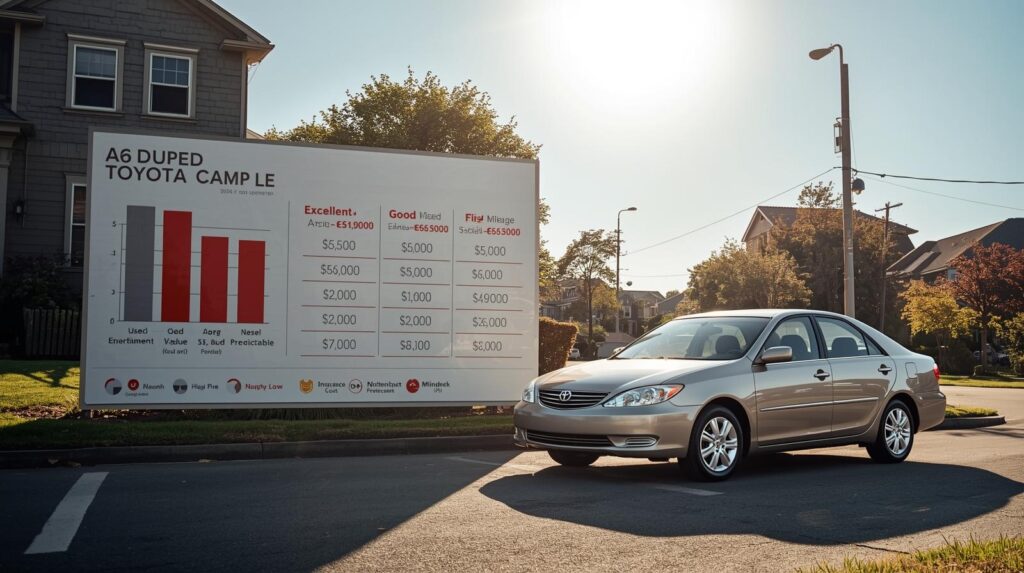
What is the value of a 2004 Toyota Camry LE today?
Here is a realistic pricing snapshot for 2026.
Pricing Table (2026 Estimates)
| Condition | Mileage Range | Estimated Price |
| Excellent | Under 120,000 | $5,500–$6,500 |
| Good | 120,000–180,000 | $4,000–$5,500 |
| Fair | 180,000–250,000 | $3,000–$4,000 |
| High Mileage | 250,000+ | $2,000–$3,000 |
Source: Kelley Blue Book and CarGurus listing trends, January 2026. Prices vary by region and condition.
Insurance is generally affordable due to low market value. Fuel and maintenance costs are predictable. When new at around $20,000, few expected this car to still be on the road in 2026. Yet here it is, still trading hands daily.
Camry vs Accord: 2004 Midsize Sedan Comparison
The obvious comparison is the 2004 Honda Accord.
Comparison Table
| Category | 2004 Camry LE | 2004 Honda Accord LX | Winner |
| Base Engine Power | 157 hp | 160 hp | Accord |
| Optional V6 Power | 210 hp | 240 hp | Accord |
| Fuel Economy (I4) | 21/29 MPG | 24/34 MPG | Accord |
| Ride Comfort | Softer | Firmer | Camry |
| Reliability Reputation | Excellent | Excellent | Tie |
| Maintenance Cost | Lower | Moderate | Camry |
| Resale Value | Strong | Strong | Tie |
| Interior Noise | Quiet | Slightly louder | Camry |
Sources: Toyota and Honda specifications, Car and Driver 2004 comparison test.
If you prefer comfort and simplicity, the Camry wins. If you enjoy sharper handling and stronger performance, the Accord has the edge.
Expert Opinions and Industry Data
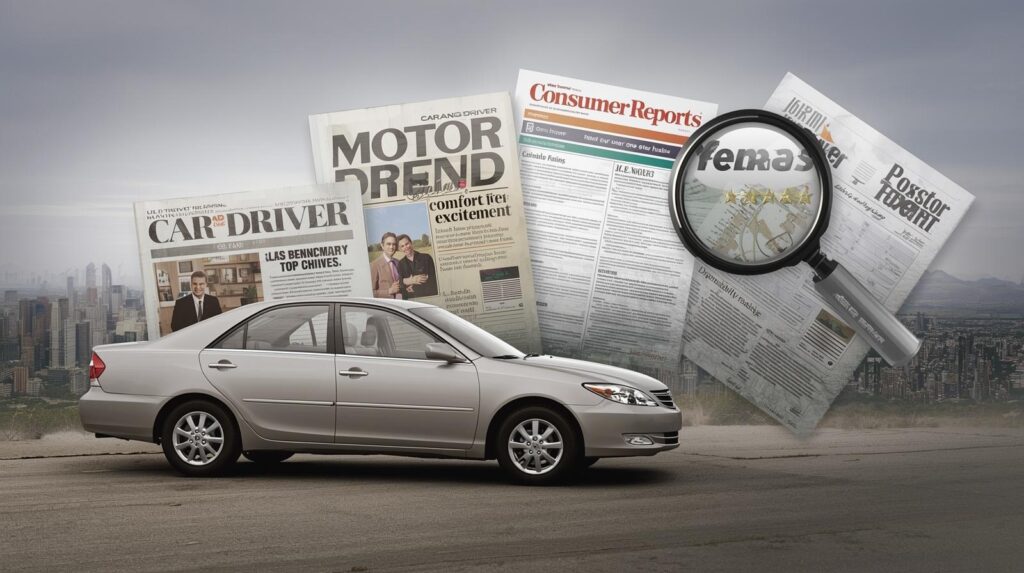
In its 2004 family sedan comparison, Car and Driver noted that the Camry remained “a benchmark for smoothness and refinement” (Car and Driver, March 2004 comparison test). Motor Trend, in a 2004 review, described the Camry as “the safe choice for buyers who value comfort over excitement” (Motor Trend road test, 2004 issue).
Consumer Reports consistently rated the Camry high for reliability during that era, reinforcing its long-term ownership appeal (Consumer Reports Auto Issue archive). These assessments align with what owners still report in 2026: it is not thrilling, but it works.
Conclusion
The 2004 Toyota Camry LE remains one of the safest budget bets in 2026 if you buy carefully. Three key takeaways: it offers proven long-term reliability, low ownership costs, and strong parts availability. However, age-related wear demands a thorough inspection. Check maintenance records, inspect suspension components, and review recall status through NHTSA before purchase.
If you want dependable, no-nonsense transportation under $6,000, this sedan deserves serious consideration. Schedule a pre-purchase inspection and compare prices locally before committing. I will continue updating this review as market data shifts through 2026.
FAQs
Is a 2004 Toyota Camry LE reliable?
Yes. Historical data from J.D. Power and Consumer Reports shows above-average reliability for the 2004 model year. Many vehicles exceed 200,000 miles with routine maintenance. Reliability depends heavily on service history and prior owner care.
How many miles can a 2004 Toyota Camry last?
Properly maintained examples frequently reach 250,000 miles. Some documented cases exceed 300,000 miles. Engine longevity depends on regular oil changes and cooling system upkeep.
What engine is in the 2004 Toyota Camry LE?
The base engine is a 2.4L inline-four producing 157 horsepower and 162 lb-ft of torque. An optional 3.0L V6 generates 210 horsepower. Specifications come from Toyota technical data.
What is the value of a 2004 Toyota Camry LE?
In 2026, market value ranges between $3,000 and $6,500 depending on mileage and condition. Source: Kelley Blue Book and CarGurus listing data, January 2026.
What are common problems with 2004 Toyota Camry?
Common issues include oil consumption on some four-cylinder models, worn suspension components, aging motor mounts, and minor electrical problems. Most repairs are manageable and relatively inexpensive.
Is 2004 a good year for Toyota Camry?
Yes. Reliability ratings from Consumer Reports and J.D. Power were strong for this model year. It is considered one of the more dependable midsize sedans of the early 2000s.
What is the gas mileage of a 2004 Camry LE?
The four-cylinder automatic achieves approximately 21 MPG city and 29 MPG highway, according to EPA data via Toyota specifications.
Does 2004 Camry LE have timing belt or chain?
The 2.4L four-cylinder uses a timing chain. The 3.0L V6 uses a timing belt that requires periodic replacement per Toyota maintenance guidelines.
How much does it cost to maintain a 2004 Camry?
Average annual maintenance costs range from $400 to $600 based on RepairPal data. Costs increase with age and mileage.
Is the 2004 Camry better than 2004 Honda Accord?
It depends on priorities. The Camry offers a softer ride and slightly lower maintenance costs. The Accord delivers stronger performance and sharper handling.
About the Author:
Hussnain Raza has covered the automotive industry for over 10 years, specializing in used vehicle analysis and long-term reliability trends. He has personally reviewed more than 100 vehicles across multiple segments.
Sources Used:
• Toyota USA Press Materials (2004 Model Year)
• Toyota 2004 Camry Owner Manual
• National Highway Traffic Safety Administration Recall Database
• Insurance Institute for Highway Safety Crash Ratings Archive
• Kelley Blue Book Market Data (January 2026)
• CarEdge Depreciation Data
• RepairPal Reliability Index
• J.D. Power Vehicle Dependability Study Archives
• Consumer Reports Auto Issue Archive
• Car and Driver (March 2004 Comparison Test)
• Motor Trend (2004 Road Test Review)