

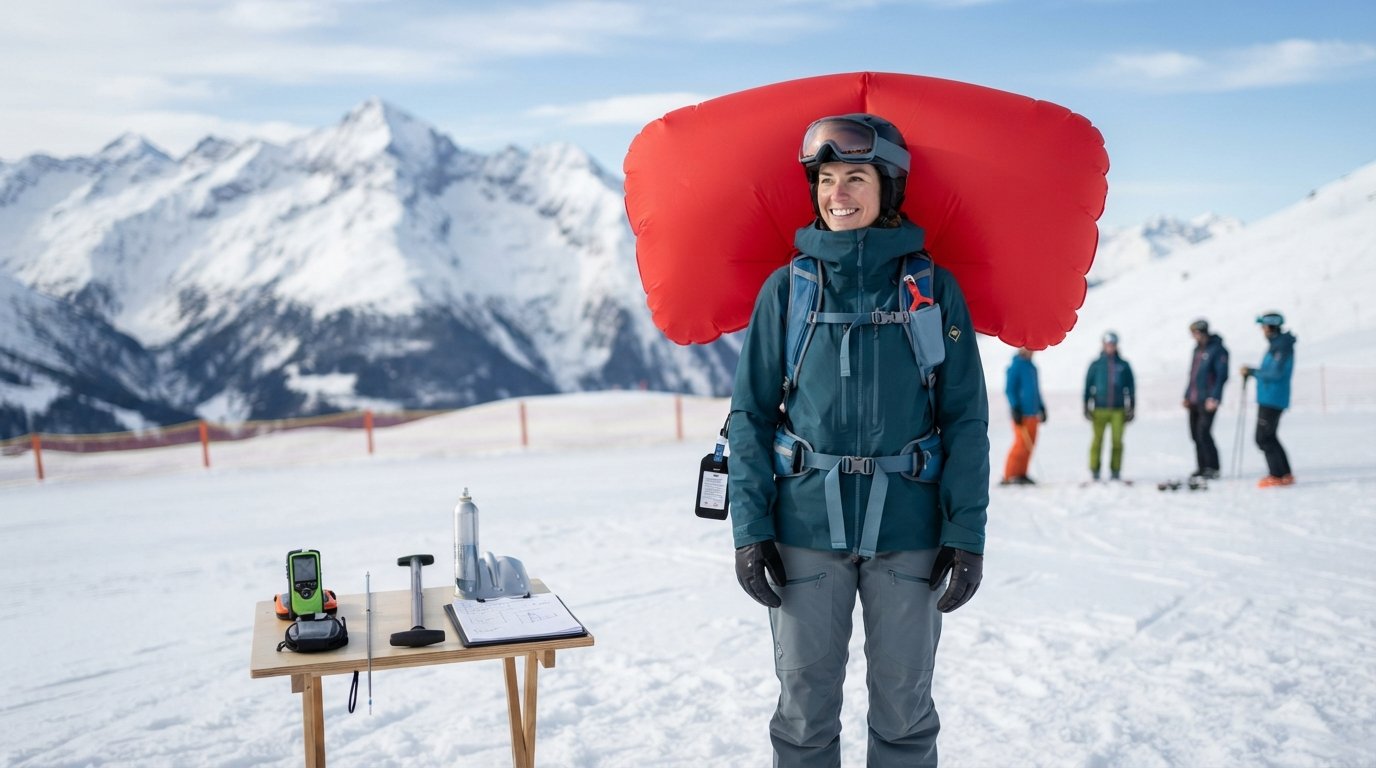
If you have an ABS avalanche airbag backpack, ABS Testauslösung means testing the airbag’s release and deployment system before relying on it in avalanche terrain.
A test activation helps you become familiar with the release mechanism and check that the system is functioning as expected. It can also reveal problems with the cartridge, release handle, airbag, or other components before you need the equipment in an emergency.
One important clarification is necessary: ABS can also refer to a vehicle’s anti-lock braking system. In the context of ABS Testauslösung, however, the term commonly refers to testing an ABS avalanche airbag, particularly in German-language outdoor and ski-touring searches.
The exact testing procedure depends on the ABS airbag system and model, so the manufacturer’s instructions should always take priority.
What Is ABS Testauslösung?
ABS Testauslösung is a test or training activation of an ABS avalanche airbag system.
An avalanche airbag is designed to help a person remain closer to the surface during an avalanche by rapidly inflating one or more large airbags. The system is activated by pulling the release handle.
A Testauslösung allows the user to become familiar with this activation process and, depending on the system and test method, verify that the deployment mechanism works correctly.
It is important to understand that a test activation is not the same as an actual avalanche deployment. The purpose is preparation and equipment verification, not emergency use.
Why Should You Perform an ABS Testauslösung?
Avalanche equipment is only useful if you know how to use it correctly and can activate it when necessary.
There are several reasons to practice with an ABS airbag:
- You become familiar with the release handle.
- You can practice pulling the handle quickly and deliberately.
- You can check the system before the season.
- You may identify damaged or incorrectly assembled components.
- You can become more comfortable with the equipment before entering avalanche terrain.
- You can confirm that the backpack and airbag have been prepared correctly.
The human factor is particularly important. In an emergency, stress, poor visibility, gloves, movement, and difficult terrain can make a simple action harder than it seems during normal conditions.
Regular practice reduces the chance that unfamiliarity with the release system becomes a problem when an actual deployment is required.
How Does an ABS Avalanche Airbag Work?
An ABS avalanche airbag is integrated into a specially designed backpack.
When the release system is activated, the inflation system rapidly fills the airbag. Depending on the particular ABS technology, the inflation system can differ between models.
The basic sequence is:
- The user recognizes an avalanche emergency.
- The release handle is pulled.
- The activation mechanism initiates inflation.
- The airbag rapidly expands.
- The inflated airbag increases the user’s effective volume.
- The system is used as part of an overall avalanche-survival strategy.
Avalanche airbags do not make a person immune to avalanche hazards. They are one component of avalanche safety equipment and should be used together with appropriate training and other essential equipment.
ABS Testauslösung vs. Real Avalanche Deployment
A Testauslösung should not be confused with an actual emergency deployment.
| Test or training activation | Emergency deployment |
|---|---|
| Performed intentionally | Triggered during an avalanche emergency |
| Used for practice and equipment checking | Used for avalanche survival |
| Conducted in a controlled environment | Takes place in unpredictable terrain |
| Helps build familiarity | Intended to assist during an actual avalanche |
| Follows the manufacturer’s test procedure | Requires immediate emergency action |
The purpose of training is to make the activation movement familiar before you actually need it.
Full Deployment vs. Dry Practice
Not every ABS system should be tested in exactly the same way.
Some systems may allow forms of practice or dry activation without completely deploying the airbag, while other procedures may require a different setup.
This is why you should never assume that a cartridge-free test is suitable for every ABS airbag.
Always check the instructions for your specific model before attempting a dry practice activation.
A useful distinction is:
Full deployment test
The airbag actually inflates.
This can provide a more comprehensive opportunity to observe the deployment process, but it also means the system must subsequently be handled correctly.
Dry or practice activation
The user practices the release action without performing a complete airbag deployment, where the specific system supports such a procedure.
This can be useful for practicing the movement of pulling the handle, but it does not necessarily verify every part of the inflation system.
A dry practice therefore should not automatically be treated as proof that the entire airbag system is functioning correctly.
When Should You Test an ABS Avalanche Airbag?
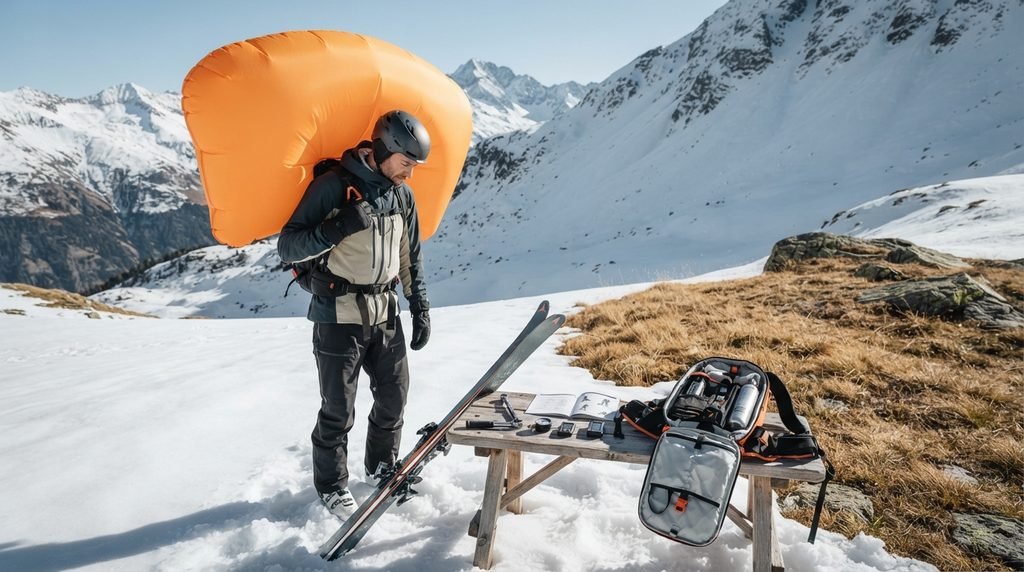
A practical time to test an avalanche airbag is before the start of a new winter or ski-touring season.
It is also sensible to consider testing or checking the system after:
- Long-term storage
- Repairs
- Reassembly
- Significant impact or damage
- Changes to the backpack configuration
- Cartridge replacement
- Extended periods without use
The exact testing and service requirements vary between systems.
A seasonal practice activation is useful because it combines equipment preparation with user training.
What Should You Check Before an ABS Testauslösung?
Before performing a test, inspect the equipment rather than immediately pulling the release handle.
Check the backpack
Look for:
- Torn fabric
- Damaged buckles
- Broken straps
- Unusual wear
- Damaged zippers
- Loose components
- Signs of impact or abrasion
Check the airbag compartment
Make sure the airbag is correctly packed and that nothing is obstructing the deployment area.
Check the release handle
Confirm that the handle is installed correctly and positioned where you can reach it naturally.
The handle should not be buried under clothing or equipment.
Check the inflation system
The cartridge or inflation mechanism must be compatible with the specific ABS system.
Do not assume that a cartridge designed for one model will automatically work with another system.
Check the manufacturer’s instructions
This is the most important step.
ABS has used different technologies and systems over time, so the correct procedure depends on the model.
How to Perform an ABS Testauslösung Safely
There is no single universal procedure that should be applied to every ABS backpack.
The correct sequence depends on the specific airbag system.
A safe general approach is:
1. Read the model-specific instructions
Identify the exact ABS system installed in your backpack.
2. Choose an appropriate location
Perform the test in a controlled area where deployment will not cause injury or damage.
Keep other people, pets, obstacles, and fragile objects away from the deployment area.
3. Prepare the backpack
Follow the manufacturer’s instructions for packing and connecting the airbag system.
4. Verify the activation handle
Make sure it is installed and positioned correctly.
5. Perform the prescribed test
Follow the manufacturer’s exact activation procedure rather than improvising.
6. Observe the deployment
If the test involves full inflation, pay attention to whether the airbag deploys normally.
7. Inspect the system afterward
Look for obvious damage, unusual behavior, leaks, or other problems.
8. Reset and repack the system
Follow the appropriate procedure for your model before considering the backpack ready for use.
What Does a Successful Test Actually Tell You?
A successful activation is useful, but it should not be misunderstood.
It can provide evidence that the tested activation and inflation sequence worked under the conditions of the test.
However, it does not guarantee that every component will work perfectly during a future avalanche.
A test does not eliminate the possibility of:
- Future mechanical failure
- Damage occurring after the test
- Incorrect repacking
- Incorrect cartridge installation
- User error
- Damage to the airbag after testing
- Problems caused by age or improper storage
For this reason, a test should be considered part of an overall equipment-check routine rather than a permanent certification of the backpack.
What Should You Check After an ABS Testauslösung?
After deployment, inspect the equipment carefully.
Check:
- Airbag fabric
- Seams
- Inflation components
- Connection points
- Release mechanism
- Backpack compartment
- Straps and buckles
- Cartridge or inflation system
- Any visible signs of damage
If anything looks abnormal, do not simply repack the backpack and assume it is ready.
Use the manufacturer’s service instructions or have the system inspected by an appropriate specialist.
What Happens to the Cartridge After a Test?
This depends on the ABS system and the type of test performed.
A full activation can consume the available gas or otherwise require the inflation system to be reset or serviced.
Some systems and practice methods are designed to allow testing without consuming a cartridge, but this is model-dependent.
Therefore, before testing, determine:
- Which cartridge your system uses
- Whether your planned test consumes it
- Whether the cartridge can be refilled
- Whether it needs replacement
- Whether the activation unit needs servicing
- How the system should be reset afterward
Never rely on a generic cartridge procedure from another ABS model.
ABS EasyTech, Solid and Other Systems
One reason ABS Testauslösung articles can become confusing is that not all ABS airbag systems operate in exactly the same way.
Different generations and technologies can use different:
- Inflation mechanisms
- Activation systems
- Cartridges
- Electronic components
- Reset procedures
- Service requirements
For example, ABS has used systems such as EasyTech and Solid, while other avalanche-airbag technology may use systems such as Alpride E2.
This means a guide describing one system should not be treated as a universal manual for every backpack carrying an ABS label.
The practical rule
Identify your exact model first, then follow the instructions for that model.
This is more reliable than copying a procedure from a general online article or a different backpack generation.
How Often Should an ABS Airbag Be Tested?
Testing frequency depends on the manufacturer’s recommendations and the condition of the equipment.
A practical approach is to:
- Practice before each winter season.
- Practice whenever you are unfamiliar with the release mechanism.
- Check the equipment after storage.
- Recheck the system after maintenance or reassembly.
- Follow the manufacturer’s recommended service schedule.
Training should also be realistic enough to build familiarity with the movement required to activate the airbag.
However, repeated full deployments should not be performed simply for practice when the manufacturer recommends another training method.
Common ABS Testauslösung Mistakes
Several mistakes can reduce the value of a test.
Mistake 1: Using the wrong procedure
An online guide for another ABS model may not apply to yours.
Better approach: identify the exact system and use its instructions.
Mistake 2: Assuming a dry test proves everything works
A practice pull may demonstrate familiarity with the handle but may not test every part of the inflation system.
Better approach: understand exactly what your chosen test verifies.
Mistake 3: Ignoring the cartridge
A cartridge is not simply a generic gas container.
Compatibility, filling, installation, and replacement depend on the system.
Mistake 4: Testing without checking the airbag
A deployment test should be followed by an inspection.
Mistake 5: Packing the airbag incorrectly afterward
Even if deployment worked correctly, incorrect repacking can affect future use.
Mistake 6: Treating the airbag as a substitute for avalanche training
An airbag is not a replacement for understanding avalanche conditions, terrain selection, companion rescue, or emergency procedures.
Mistake 7: Waiting until the first trip of the season
Discovering a problem at the trailhead is much worse than finding it during pre-season preparation.
Does an ABS Airbag Replace an Avalanche Beacon, Shovel and Probe?
No.
An avalanche airbag is only one part of an avalanche-safety system.
Backcountry users should also understand the role of appropriate avalanche equipment and training, including:
- Avalanche transceiver
- Avalanche probe
- Snow shovel
- Companion-rescue skills
- Avalanche forecasting
- Terrain assessment
- Route planning
- Appropriate decision-making
An airbag cannot prevent an avalanche from occurring, and it cannot eliminate all avalanche-related risks.
ABS Testauslösung and Avalanche Training
Equipment practice is most valuable when it is combined with broader avalanche education.
A user should know not only how to pull an ABS release handle but also:
- When avalanche conditions become dangerous
- How to interpret avalanche forecasts
- How to choose appropriate terrain
- How to perform a companion rescue
- How to use a transceiver
- How to use a probe
- How to use a shovel effectively
- When to avoid entering avalanche terrain
The goal is not simply to own an airbag backpack.
The goal is to understand how the equipment fits into a complete avalanche-safety strategy.
What If the ABS Airbag Does Not Deploy During the Test?
Do not continue using the system as though nothing happened.
First, stop and determine why the test failed.
Potential issues can include:
- Incorrect setup
- Incorrect cartridge
- Improperly installed components
- Release-handle problems
- Incorrect packing
- Damaged components
- System-specific technical issues
Do not repeatedly activate the system in an attempt to make it work.
Instead, consult the instructions for your exact model and contact an appropriate ABS service provider if the problem cannot be clearly resolved.
ABS Testauslösung: Quick Checklist
Before the season, use this simple checklist:
- Identify the exact ABS airbag model.
- Read the current manufacturer’s instructions.
- Inspect the backpack.
- Inspect the airbag compartment.
- Check the release handle.
- Confirm the correct cartridge or inflation system.
- Check whether your system supports dry practice.
- Perform the appropriate test in a safe location.
- Inspect the equipment after deployment.
- Reset and repack according to the manufacturer’s instructions.
- Arrange service if anything appears damaged or abnormal.
- Practice your complete avalanche emergency routine.
Frequently Asked Questions About ABS Testauslösung
What does ABS Testauslösung mean?
ABS Testauslösung generally refers to testing or practicing the activation of an ABS avalanche airbag. It allows the user to become familiar with the release system and, depending on the test method, check aspects of the airbag’s deployment system.
Is ABS Testauslösung related to car brakes?
It can be, because ABS also means anti-lock braking system in automotive terminology. However, in the context of avalanche equipment, ABS Testauslösung refers to testing an ABS avalanche airbag.
How often should I test my ABS avalanche airbag?
A seasonal test or training activation is a sensible part of equipment preparation, but you should follow the testing and service recommendations for your exact ABS system.
Can I test an ABS airbag without a cartridge?
Some systems or training methods may support cartridge-free practice, but this is not universal. Never assume that a dry activation procedure applies to your particular model.
Does a successful test mean my ABS airbag is completely safe?
No. A successful test provides useful information about the tested system under those conditions, but it cannot guarantee future performance or rule out damage, incorrect repacking, mechanical problems, or user error.
Do I need to replace the cartridge after testing?
It depends on the type of test and the specific ABS system. A full deployment may require the inflation system to be refilled, reset, or replaced according to the manufacturer’s instructions.
Can I use instructions for another ABS backpack?
You should not. Different ABS systems can use different activation and inflation technologies. Always identify your exact model before following a testing procedure.
What should I do if the airbag does not deploy?
Stop using the system until the problem is understood. Check the model-specific instructions and, when necessary, have the equipment inspected or serviced by an appropriate professional.
Is an avalanche airbag enough for avalanche safety?
No. An avalanche airbag should be considered one part of a broader safety strategy that includes appropriate training, avalanche awareness, terrain assessment and essential rescue equipment.
Final Thoughts
ABS Testauslösung is an important part of preparing an ABS avalanche airbag for real-world use. A properly performed test can help users become familiar with the release mechanism and identify obvious equipment problems before entering avalanche terrain.
The most important point is that there is no universal ABS test procedure for every backpack. ABS has used different systems and technologies, and cartridge requirements, activation methods and reset procedures can vary.
For that reason, identify your exact model and follow the manufacturer’s current instructions.
Most importantly, treat the airbag as one part of a complete avalanche-safety system. Regular equipment checks, practical training, appropriate rescue equipment and sound avalanche decision-making all work together to reduce risk in the backcountry.